The short answer
Your credit card works in monthly cycles. Everything you spend during a cycle is collected into one statement on the statement date. You then have a fixed window, usually around 15–20 days, until the due date to pay it.
Pay the total amount due by the due date and you pay no interest. Pay only part of it, or only the minimum due, and interest starts on the whole balance, usually including new purchases. That one rule matters more than any reward or offer.
The four dates and amounts that matter
| Term | What it means |
|---|---|
| Billing cycle | The period your spends are grouped into, for example 16 Oct – 15 Nov |
| Statement date | The day the cycle closes and your bill is generated (15 Nov here) |
| Payment due date | The last day to pay without late fees or interest, often around 18–20 days after the statement date |
| Total amount due | Everything you owe for that statement. Pay this. |
| Minimum amount due | A small part (often around 5%) that keeps the account "not late", but not interest-free |
A worked example
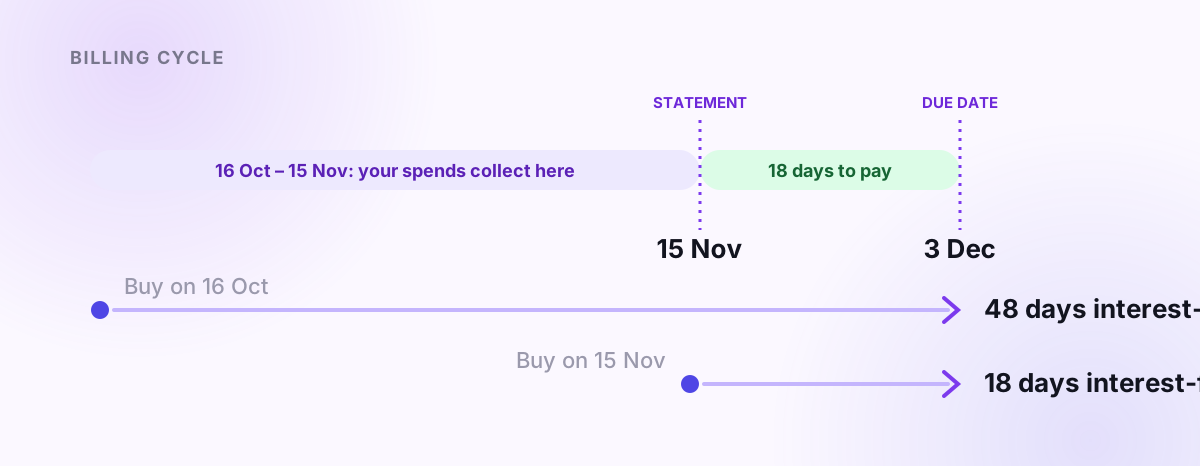
Say your cycle is 16 Oct – 15 Nov, your statement date is 15 Nov, and your due date is 3 Dec.
| You buy on… | It appears on… | Pay by… | Interest-free days |
|---|---|---|---|
| 16 Oct (first day of cycle) | 15 Nov statement | 3 Dec | 48 days |
| 1 Nov (middle) | 15 Nov statement | 3 Dec | 32 days |
| 15 Nov (statement day) | 15 Nov statement | 3 Dec | 18 days |
| 16 Nov (day after) | 15 Dec statement | early Jan | ~48 days again |
That's what "up to 50 days interest-free" means: up to, depending on where in the cycle you spend. A big planned purchase made just after your statement date gets the longest time before you have to pay.
The minimum-due trap
The statement always offers you a much smaller "minimum amount due". Paying it avoids a late fee, but here's what usually happens when you don't pay the total:
- Interest is charged on the unpaid balance, often from the original purchase dates, not from the due date.
- You lose the interest-free period on new purchases until the balance is cleared, so even today's coffee starts collecting interest.
- Rates are high. Card interest in India commonly runs at about 3–3.75% a month, roughly 36–45% a year, plus GST on the interest.
A rough example: leave ₹40,000 unpaid at around 3.5% a month and you'll pay about ₹1,400 in interest for that month alone, plus GST, plus interest on whatever you spend next. Do that for a few months and you've paid for something twice.
If you genuinely can't pay in full, paying as much as you can still reduces the interest. If it keeps happening, converting the balance to a fixed-rate EMI (ask your issuer, and compare its rate) is usually cheaper than revolving.
Late payment: what it costs
Missing the due date entirely usually means:
- a late payment fee (based on how much you owe),
- interest as above,
- and, if it's reported as overdue, a hit to your credit score, which affects future loans.
Set up autopay for the total amount due from your bank account if your issuer offers it. It's the simplest way to never pay interest by accident.
Can you change your billing cycle?
Yes. RBI rules require card issuers to let you change your billing cycle (at least once). If your salary arrives on the 1st but your due date is the 28th, ask your issuer to move the statement date so the due date falls a few days after payday. One phone call or app request removes a monthly scramble.
How to keep card spending under control
- Track card spends as you make them, not when the statement arrives. The statement is history; the cycle is still open.
- Know your statement date for each card. Time big planned purchases for just after it.
- Keep total card spends inside your monthly budget. The card is a payment method, not extra money.
- Separate the bill payment from spending. When you pay your card bill from your bank account, that's not new spending; you already spent it when you swiped. Counting both makes your month look twice as expensive. (More on this in tracking EMIs and credit card bills.)
How PaisaSync helps
PaisaSync reads your card alerts on your phone and records each swipe, online payment and RuPay-on-UPI payment against the right card as it happens, so you can see the open cycle before the statement does. When you pay the bill, it recognises the payment as settling the card, not as new spending or income, so nothing is counted twice.
Bottom line
Know your statement date, pay the total amount due by the due date, and never treat the minimum due as the bill. Do that and a credit card is up to 50 days of free credit plus rewards. Skip it and it's one of the most expensive loans available.
PaisaSync tracks every card spend as it happens, privately on your phone, so the statement is never a surprise.