The short answer
A monthly budget is just a plan for your salary before it arrives, instead of an explanation for where it went after. For most salaried people in India, a workable starting point is:
- 50% needs — rent, groceries, utilities, EMIs, insurance, commute.
- 30% wants — eating out, shopping, trips, subscriptions.
- 20% savings — emergency fund, SIPs, PPF, goals.
Then you adjust it to your real life, which in an Indian city often means rent and family commitments take more than half. That is fine. The rule is a starting shape, not a law.
Below is the whole process in five steps, with a worked example on a ₹50,000 monthly take-home salary.
Step 1: Start from take-home, not CTC
Your CTC includes things that never reach your account: employer PF, gratuity, sometimes insurance and variable pay. Budget from the in-hand amount that lands on salary day.
Not sure what that number is after tax and PF? The salary calculator and income tax calculator will estimate it.
Step 2: List your fixed commitments first
These are payments that happen whether or not you think about them:
- Rent or home-loan EMI
- Other EMIs (phone, bike, personal loan)
- Insurance premiums
- Money sent home to parents
- School fees
- Recurring subscriptions and recharges
Add them up. This is the part of your salary that is already spent on the 1st of the month. Many people are surprised by how large it is — which is exactly why you write it down.
Step 3: Pay yourself before you spend
Decide the savings amount now and move it on salary day — an auto-debit SIP, an RD, or a transfer to a separate account. What is left after needs and savings is what you can actually spend.
If you are building an emergency fund, aim for three to six months of essential expenses first. The SIP calculator and RD calculator show what a fixed monthly amount grows into.
Step 4: Split the rest into category budgets
"₹15,000 for wants" is too vague to follow. Break it into the categories where your money actually goes — food delivery, shopping, travel, entertainment — each with its own limit.
Step 5: Track against it automatically
This is where most budgets die. A plan made in a spreadsheet on the 1st is forgotten by the 10th, because every UPI payment in between needs to be typed in.
The fix is to let your spending record itself. An SMS-based tracker like PaisaSync reads the bank and UPI alerts already on your phone, files each payment under a category, and shows how much of each budget is left. You make the plan once; the tracking happens on its own.
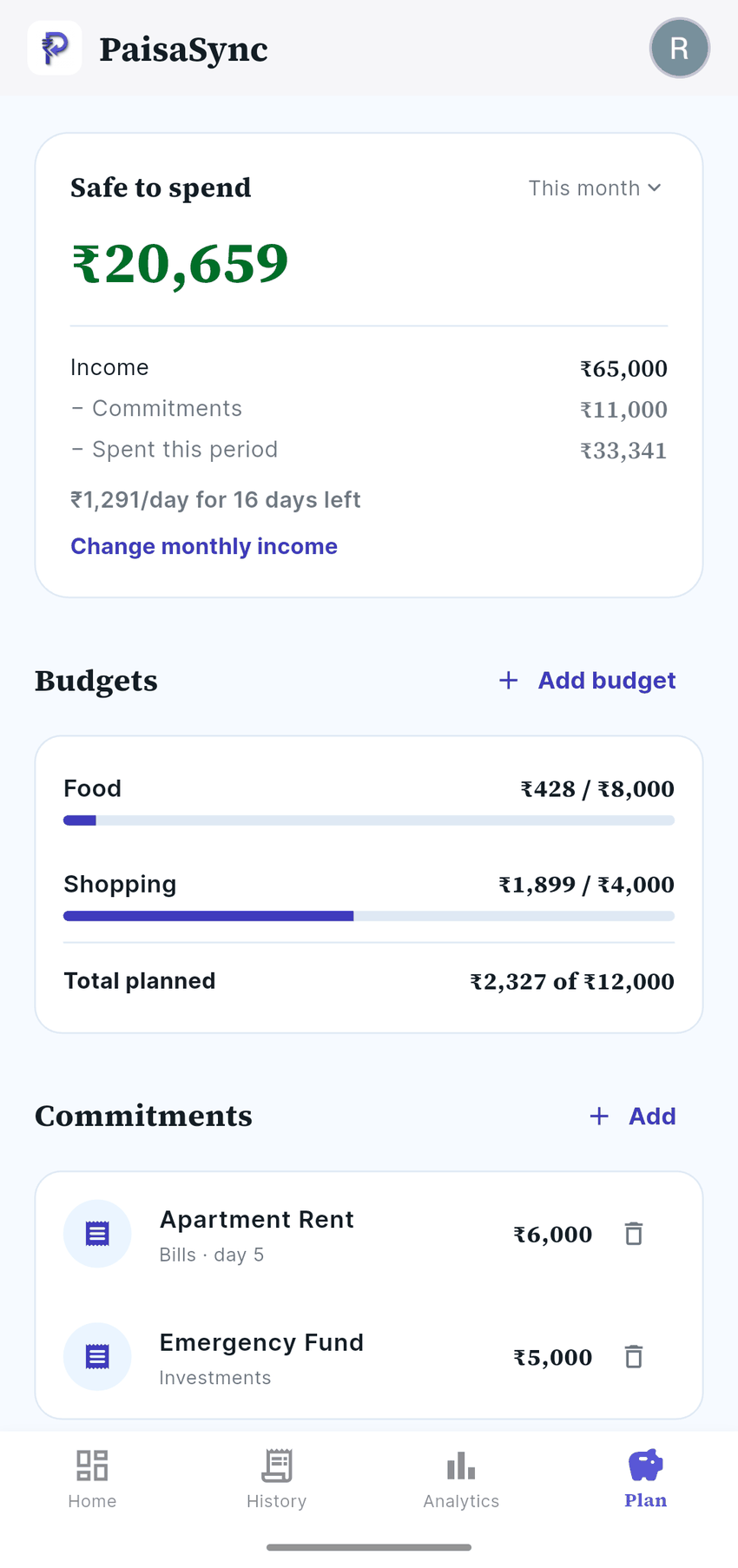
Worked example: ₹50,000 take-home
Here is a realistic plan for a single person renting in a metro. Your numbers will differ; the shape is what matters.
| Category | Type | Monthly (₹) |
|---|---|---|
| Rent (shared flat) | Need | 14,000 |
| Groceries & household | Need | 5,000 |
| Electricity, internet, mobile | Need | 2,000 |
| Commute (metro, autos, fuel) | Need | 2,500 |
| Health insurance premium | Need | 1,000 |
| Money home to parents | Need | 3,000 |
| Needs total | 27,500 (55%) | |
| Food delivery & eating out | Want | 4,500 |
| Shopping | Want | 3,000 |
| Entertainment & subscriptions | Want | 1,500 |
| Travel / weekend trips | Want | 3,500 |
| Wants total | 12,500 (25%) | |
| Emergency fund | Savings | 5,000 |
| SIP | Savings | 5,000 |
| Savings total | 10,000 (20%) | |
| Total | 50,000 |
Needs came in at 55%, not 50%, because metro rent is expensive. So wants were trimmed to 25% to protect the 20% savings. That is the kind of trade-off a budget exists to make visible.
The daily number that makes it stick
A monthly budget is easy to plan and hard to feel. What helps is turning it into a per-day figure:
Safe to spend today = (income − fixed commitments − savings − spent so far) ÷ days left in the month
If it is the 12th and you have ₹8,000 of discretionary money left with 19 days to go, you can spend about ₹420 a day. That one number is far easier to act on than a spreadsheet. PaisaSync calculates it for you as a Safe-to-Spend figure, updated with every transaction.
Common mistakes
- Forgetting annual costs. Insurance renewals, Diwali shopping, school fees. Divide them by 12 and set that amount aside monthly.
- Budgeting only for big categories. Small UPI payments add up surprisingly fast — see the ₹200 problem.
- Giving up after one bad month. Overspending in month one is data, not failure. Move the limits closer to reality and continue.
- Letting EMIs grow unnoticed. A good rule of thumb is to keep total EMIs well within a third of take-home. Check a new loan with the EMI calculator before you sign.
Start this month
- Write down your take-home and fixed commitments.
- Pick a savings amount and automate it on salary day.
- Set four or five category limits for the rest.
- Install PaisaSync so your UPI and card spending tracks itself against those limits.
A budget you can see without effort is the only kind that survives past the second week.